Tip
The forward-most point of the blade. Its geometry affects piercing precision and strength.
 BLADE/ANATOMY
A collector’s visual glossary
From the tip to the tang, every line has a name and a job. Start with the two that get mixed up most often: the choil is a notch or recess; the ricasso is a flat, unsharpened section of blade.
See the difference ↘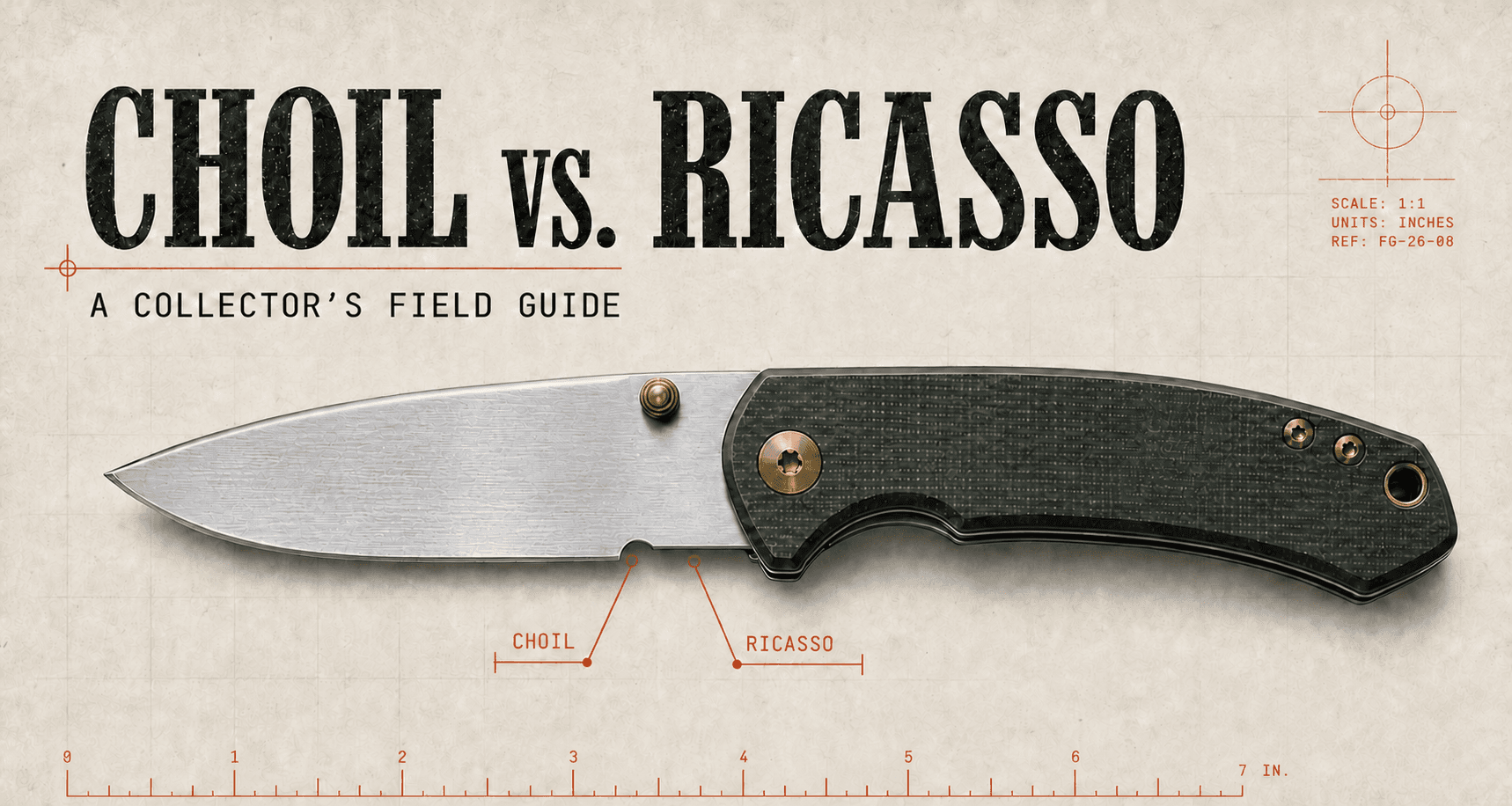
A notch or curved recess. It may give sharpening clearance or make room for a finger.
The flat, unsharpened blade section between the grind and handle or guard.
01 / The working vocabulary
Knife geometry is not decoration. These transitions affect cutting, sharpening, grip, carry, and strength.
The forward-most point of the blade. Its geometry affects piercing precision and strength.
The curved part of the cutting edge. More belly gives a longer slicing arc.
The large bevel that thins the blade from its full stock toward the cutting edge.
The narrow, sharpened bevel that forms the cutting apex.
The back of the blade opposite the cutting edge, usually left at full or near-full thickness.
A bevel along the spine that reduces mass and can improve penetration. It may be sharpened or false.
Machined grooves that add traction for a thumb or finger.
The visible transition where the primary grind ends near the base of the blade.
The flat, unsharpened blade section between the grind and the handle or guard.
A small notch between the cutting edge and ricasso that gives a sharpener clearance.
A larger curved recess near the blade-handle junction, shaped to accept a finger.
The part of a fixed blade that continues into or through the handle.
02 / The important nuance
The locations stay relational, not absolute. Designs move, enlarge, blend, or omit these features.
Configuration A
A small relief notch sits between the end of the sharpened edge and the ricasso. It lets a stone reach the heel without climbing the ricasso shoulder.
Configuration B
A larger recess sits at the blade-handle junction. It may be cut entirely into the blade or formed partly by blade and handle, depending on the design.
Configuration C
The edge may transition into the ricasso without a distinct cutout. Some designs also minimize the ricasso until the transition is visually subtle.
If an arrow points to a small semicircular notch at the heel of the edge, it is pointing to a choil. The ricasso is the broader unsharpened flat beside that notch, not the notch itself.
The compact sharpening choil exists mainly to separate the cutting edge cleanly from the ricasso. A finger choil is ergonomic: it creates a forward index-finger position for control. Calling both a “choil” is normal, but the qualifier matters.
The ricasso is part of the blade, commonly left at or near full stock thickness. It provides transition space between the ground blade and handle or guard, often carries a maker’s mark, and can contribute strength near the junction.
03 / Reference bench
Usage can vary by knife category, especially in culinary knives and historical swords. For the modern folding and fixed-blade definitions above, we cross-checked manufacturer glossaries.
Kershaw knife anatomy ↗Spyderco glossary ↗Smith & Wesson knife glossary ↗From anatomy to apps
Compare CHOIL, Scales, Ricasso, BladeVault, and Knifomatic for knife collections, Inventry for broader inventories, and Notion or Airtable for a database you build yourself. Drop Beacon joins the guide for EDC discovery, creator storefronts, giveaways, and paid market tools. Compare each option’s strengths and limits.
Publisher disclosure: Blade Anatomy and the linked comparison are published by Airglow, LLC, maker of CHOIL. Neither is affiliated with or endorsed by Ricasso, BladeVault, or Drop Beacon.
Compare all nine tools ↗